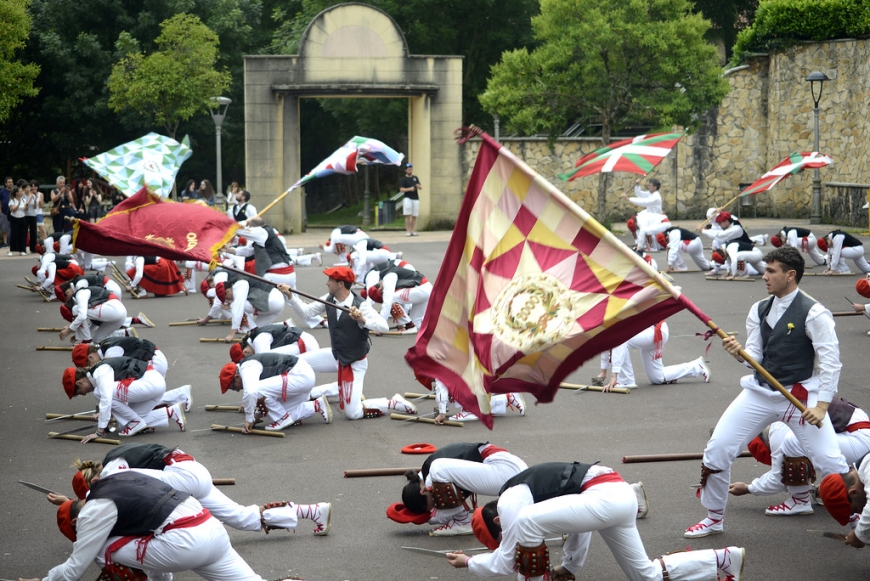
In the Basque Country, dance is a vital means of expressing collective identity. This tradition has been passed down through the centuries thanks to the unique bond that unites the Basques with their dances. Throughout this long journey, the movements, rituals and meanings have continued to evolve and be (re)invented.
But what exactly do we mean today when we refer to ‘Basque dances’?
Everyone seems to have their own perspective, often pitting tradition against creativity. However, upon closer examination, focusing mainly on the seminal studies by anthropologist Xabier Itçaina, director of research at the French National Centre for Scientific Research (CNRS), the history of Basque dance reveals a shift away from its original uses, as well as a continuous redefinition of its many forms.
Retrospective: When Dance Drifts from Its Original Meaning
Dance Tradition under Ecclesiastical Oversight
In the Basque Country, dance still plays an important role in many religious festivals today. In the nineteenth century, the Church used Basque dances in the context of its conflict with the State. To assert its authority, the Church interspersed elements of pagan rituals into Catholic rites.
Several accounts describe how the Church condemned festive gatherings in which the faithful indulged in ‘frivolous and excessive’ practices, as well as new social dances, viewing them as immoral recreational activities. Similarly, it condemned the paganism of ritual practices in which dancers indulged in various ‘superstitions’. In contrast, the Church tolerated and even promoted certain Basque dances in the name of moral and political conservatism.
These dances, performed mainly by men and with no contact between dancers, already form the basis of ‘Basque’ dances, strictly speaking. It is interesting to note that, in the second half of the nineteenth century, it was priests who recorded these dances. Dance thus became the symbol of an idealised, rural and Catholic Basque society.
Photo: Marie Claire Bouchdu
Dance in the Service of Basque Nationalism
At the beginning of the twentieth century, the instrumentalisation of Basque dances initiated by the Church continued with the development of nationalism. Dance shifted away from its ritual and traditional roots to become a symbol of a new conversation about identity. At that time, a patriotic repertoire was highly valued, based mainly on the ‘dantzari dantza’ of the villages of the Merindad de Durango (Berriz, Iurreta, Garai). This dance combined warrior games with sticks or swords and often represented the colours of the recent Basque flag, designed in 1893 by Sabino Arana Goiri. These dances were taught to young people, simplified and altered, and were used as further proof of Basque distinctiveness.
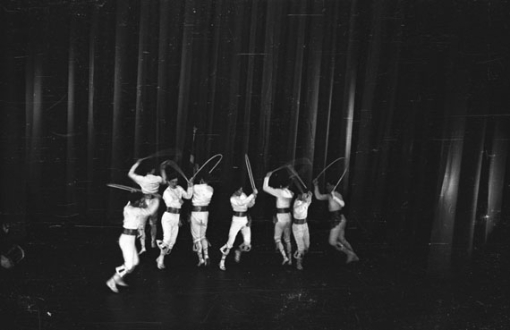
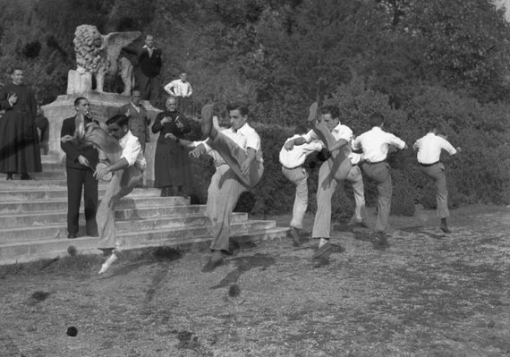
With the outbreak of the Spanish Civil War, Basque dance gained prominence following the creation in 1937 of the music and dance group Eresoinka by the Basque Government. The mission of this cultural ensemble was to explain to the world—through music and choreography—the situation the Basque Country was experiencing. Initially based in Sara and later in Saint-Germain-en-Laye, the company brought together more than one hundred artists and gave numerous performances in Paris, Brussels, Amsterdam, and London. In 1939, Eresoinka was contracted to undertake an extensive tour of North America, but the outbreak of war forced the transatlantic ship carrying the group to return to France. Thus, Eresoinka’s trajectory came to a definitive end.
We may never make it out of here. But that doesn’t mean the fight can’t continue on an artistic level… Why not use our most beautiful melodies to show the world the memory of a people dying for freedom”, Jose Antonio Agirre, former president of the Basque Government
With those words, spoken between the bombing of Gernika and the fall of Bilbao, Lehendakari José Antonio Agirre envisioned what would become Eresoinka, a mixed vocal, instrumental, and dance ensemble created during the Spanish Civil War.
Eresoinka´s performance in London. Photo: Jesus Elosegui Irazusta
Members of Eresoinka at Chateau Belloy. Photo: Jesus Elosegui Irazusta
During the Republic prior to the war, in the Basque territories within the Spanish state, and under the impetus of the Euzko Alderdi Jeltzalea, the first folk groups began to emerge. These would later spread to the Northern Basque Country. During the Franco regime, for example, numerous Basque refugees established new groups there, and their contribution played a significant role in shaping what we now know as Basque dance. The phenomenon was considerable in scale: Ballet Olaeta—which would later give rise to the Oldarra Ballet of Biarritz and the creation of Etorki Balletak—as well as Batz-Alai of Bayonne, Begiraleak of Saint-Jean-de-Luz, Elkar Oinka of Hasparren, and Oinak Arin of Briscous and Itxassou, among others.
Folklorisation and institutionalisation
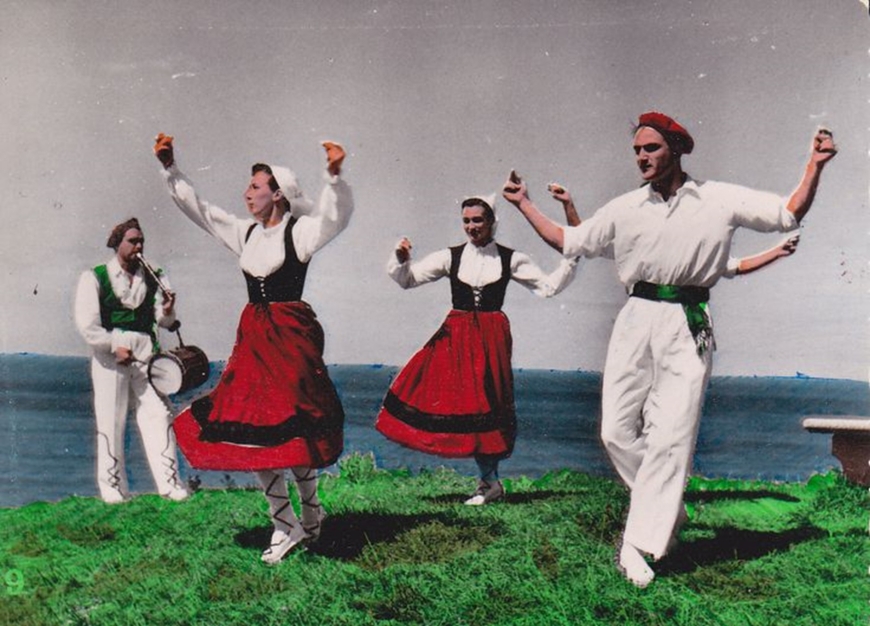
In the post-war period, the proliferation of dance groups in the Basque Country played a key role in integrating Basque dances into formal cultural organizations and practices. In the 1960s and 1970s, these rapidly growing groups embraced a collaborative, association-based way of operating. This new model applied a business approach to managing the groups’ activities, including costume production, purchasing stage equipment, selling performances, and organising trips.
Photo: Idoia Lahidalga
The folk movement gradually adapted to the development of tourism, shaping a definition of Basque dances around the myth of Zazpiak-bat (seven in one). During this period, particular local traditions were often neglected, and calendar and ritual dances experienced a clear decline, giving way to more spectacular dances that symbolised the unity of the seven Basque provinces. Once again, dance was reinterpreted and reused for strategic purposes.
Permanent transformation
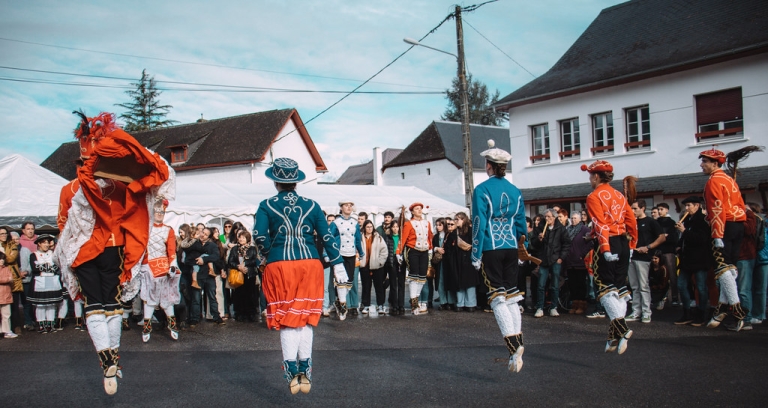
Gradually instrumentalised and institutionalised, Basque dances were made to serve the Church and shaped to fit the foundational myth of Basque nationalism, and even the folklore movement and tourism. Over the centuries, dances have increasingly shifted away from their traditional roles
Ezpata Dantza Day at Mallabia. Photo: Txelu Angoitia
Far from simply losing meaning, these successive uses are now generating new forms of expression, creating a vibrant and diverse dance tradition that is constantly changing, providing new definitions of what we now call Basque dance(s).