The San Juan, symbol of the Basque maritime heyday, sank off the coast of Canada in 1565. Nearly 500 years later, a shipyard in Pasaia has managed to build an exact replica, set to be launched on a voyage to Newfoundland.
Sunken, discovered and reconstructed: the story of a 16th-century Basque whaling ship, unique in the world
04 Jun 2026
A crush on the National Geographic
In the mid-1980s, a young Xabier Agote, fascinated by old wooden fishing boats since he was a child, was in for the surprise of his life when he read the following headline on the cover of National Geographic: ´16th-Century Basque Whaling in America´. The article recounted the story of the San Juan, a whaling ship that sank on a stormy night in 1565 in the frigid Canadian waters of Red Bay. The vessel was 28 metres long, had a cargo capacity of 200 tonnes and was outfitted for 60 crew members – a remarkable technological achievement that today symbolises the Basque maritime industrial heritage.
It actually all begun a few years earlier. In 1978, a team of Canadian archaeologists (from the public agency Parks Canada) discovered the San Juan at a depth of around 10 metres, buried beneath a thick layer of ballast stones and sediment. They had been following clues uncovered by historian Selma Huxley in the archives of Oñati, Basque Country, and in the Spanish cities of Burgos and Valladolid. The divers who inspected the wreck found, against all odds, that the ship – one of the first transoceanic cargo vessels to ply the seas from the Basque Country to Newfoundland – was in good condition. The wood and some of the ropes had withstood the passage of time remarkably well. For 30 years, under the direction of researcher Robert Grenier, who died in early 2026, an extensive study was conducted that became a landmark in underwater archaeology.
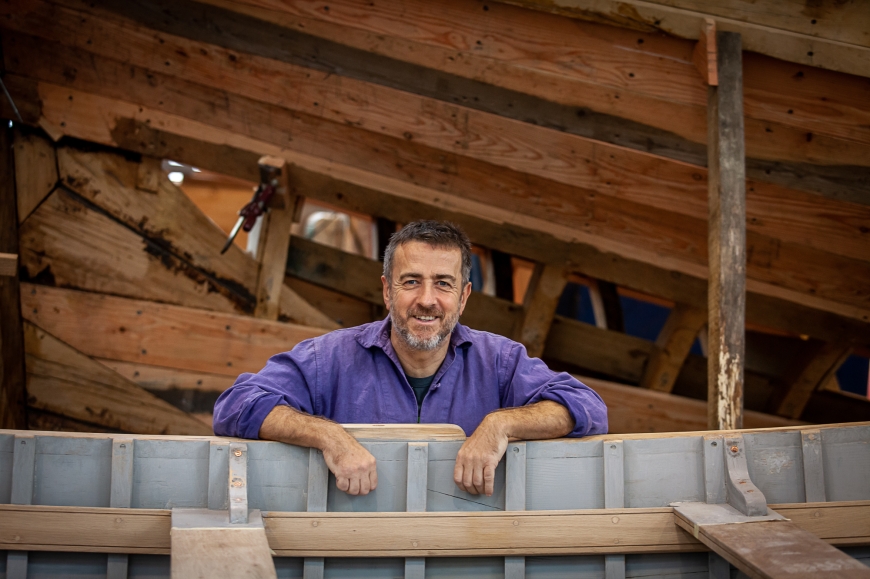
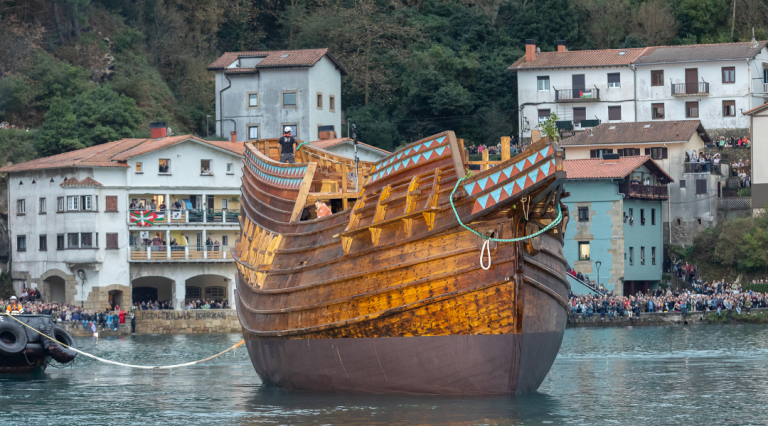
Agote sits at his office desk at Albaola in Pasaia San Pedro. This unique shipyard-museum on the coast of Gipuzkoa specialises in building historic vessels. It is a special place. A replica of the San Juan has been built here after more than 10 years of intense work. The mega-project reached a major milestone when the ship was launched into Pasaia Bay on 7 November 2025. The ship is being prepared for its first major mission: to recreate the 16th-century Basque voyage to the coast of Newfoundland.
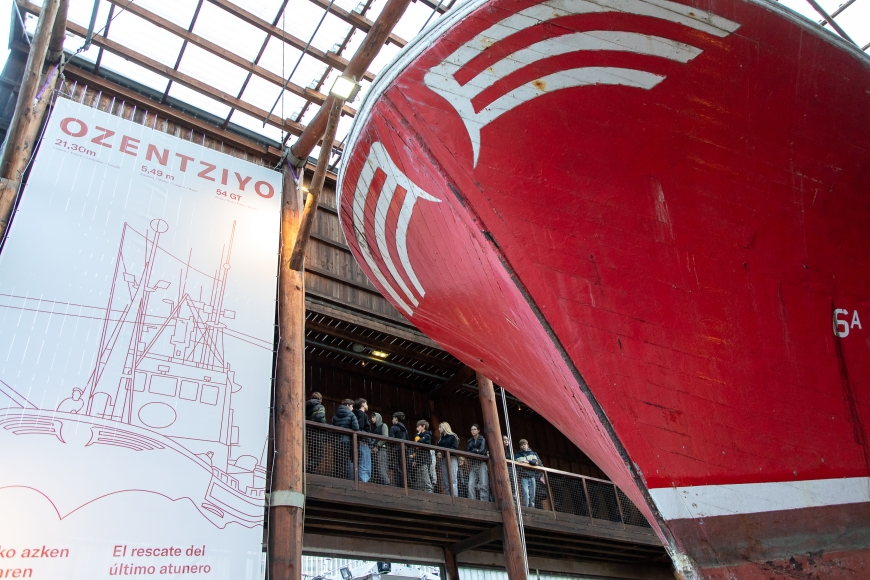
At the same time, a group of workers and volunteers from around the world are restoring a 19th-century traditional wooden fishing boat called the Ozentziyo. This restoration project adds a touch of romance: it is the last vessel that was used for tuna fishing in the port of Donostia. Had it not been restored, it would have been scrapped, along with the memory of the fishermen from the Basque coastal waters.
The founder and president of Albaola looks back to 1985. In the digital age, information constantly appears and disappears as one scrolls through their mobile phone. The influence once held by a printed front page has all but vanished, overshadowed by the far greater impact of a viral Instagram reel. But who could forget a crush like this, both a teenage infatuation and a moment of awakening? That Basque whaling ship featured in National Geographic, was hailed as the maritime Holy Grail of the 16th century: "It changed my life, it was a stroke of luck. And I said to myself, ´I’m going to be the one to restore the boats that nobody wants´."
Lower the sails! A gift from the Basque diaspora
1997, Maine, United States. Xabier Agote is obsessed with preserving the naval legacy of his Basque ancestors and decides to create Albaola, an association meant to “raise awareness around the Basque Country’s universal maritime past”. Albaola was founded as a cultural revolution aimed at dismantling entrenched clichés in the collective imagination and rewriting the narrative of the contributions made by Basque seafarers through their exploits on the high seas centuries ago.
“It’s absolutely incomprehensible how our true cultural identity as a people has been hidden from us over the centuries,” laments Agote. “We’re fundamentally a seafaring people; in fact, I’d say we’re oceanic. Our defining characteristic has been a connection to the sea, even though we’ve often been told that Basque culture is primarily pastoral. I couldn’t understand why our most extraordinary, captivating, brilliant and impressive characteristic wasn’t being given the recognition it deserved.” He adds, “There was nothing to revive such a glorious past, the time when we were at our greatest as a people.”
In the 16th century, during the reign of Charles I of Spain and V of Germany, Basque sailors not only ventured out to hunt right whales, but were also “pioneers in establishing trade links between Europe and North America”. Along the roughly 100 kilometers of Basque coastline, from Bayonne to Muskiz, “the world’s most advanced ocean-going ships were built", Agote explains. “Without a doubt, these ships were used not only by Basque merchants and transporters but also by the Spanish Empire. More than 80% of the naval fleet of Charles V’s empire was built on the Basque coast.”
The trainera fishing boat Ameriketatik (‘from America’), a descendant of the whaling boats used by Basque fishermen in the 18th century, was Albaola’s first project. The $75,000 cost of construction was funded through the collective efforts of the Basque diaspora in America and Australia. The project also received assistance from students at The Apprenticeshop, a boatbuilding school in Maine. “A fishing boat built in the United States, funded by the Basque diaspora and gifted to the Basque Country. It was a fantastic campaign,” concludes Agote.
The Ameriketatik was launched in Maine on 10 May 1998 and set off on its maiden voyage to New York. Agote himself was the skipper of the trainera, which sailed through Manhattan Bay with American sailors on board. This further strengthened the bonds between the Basques, the sea, and America. The fishing boat then made 29 stops at ports along the coast, each time crewed by 12 different oarsmen and sailing traditionally using only oars and sails, without any engine or modern technology.
Agote points out that the Ameriketatik project revealed the Basque connection to the islands of Saint Pierre and Miquelon. This French overseas territory located south of Newfoundland is home to approximately 6,000 people. “As the sole maritime context in the Basque diaspora, it was a true milestone. Other members of the Basque diaspora across the Americas didn’t know about it, so it was wonderful they learned of it.”
The Basque NASA and Old World rockets
Walking through Albaola and pausing to observe its inner workings is the closest thing to a journey through time. Every trade practised in this vibrant, living shipyard-museum bears the hallmark of craftsmanship and is reminiscent of a bygone era. The air is filled with the scent of freshly worked wood – a comforting aroma that mingles with the piercing sounds of the saw, the adze and the axe. You can even see a blacksmith’s workshop where they make the nails. The shipwrights and carpenters who eked out a living in centuries past and had no access to electricity (let alone YouTube tutorials) must have been very much like these Basque and international workers from Germany, France and Latin America.
The Albaola team has created a unique, authentic environment that empowers them to confidently undertake reconstruction in an age where machines have replaced many trades and traditional know-how have nearly vanished. Hugo Almonacid (aged 36) from Chile is part of this multicultural maritime crew, where everything is built using age-old, traditional techniques. He came to Albaola in 2025 as a master shipwright and set to work on the whaling ship San Juan. His is a dying trade which, nevertheless, fits like a glove in this unique setting where every worker leaves their personal mark.
Five hundred years ago, the Americas were practically a distant galaxy connected by the sea. Agote often compares today’s NASA with the 16th-century shipyards of Pasaia, and its port with Cape Canaveral. “Those ships were the rockets that set sail for the New World. The Basques founded the first school of transoceanic navigation in Cádiz. Elcano’s circumnavigation of the globe [between 1519 and 1522] was organised from Lekeitio. The nao Victoria and the nao Trinidad were Basque ships. None of this is a coincidence. The Basques were the only industrial-scale whalers in the world, a people who were simultaneously building ocean-going ships and hunting whales in the most remote and inhospitable places on the planet: Iceland, Canada, Norway, Greenland… It was quite astonishing.”
It was in Pasaia, in fact, where the original San Juan was built, and it remains underwater today, protected and monitored by the Canadian authorities. Her wreck is a unique relic of the heyday of the 16th-century whaling industry and has been designated a UNESCO World Heritage Site. The image of the San Juan was adopted by the United Nations as the official symbol of the world’s underwater heritage, representing all the sunken ships around the globe. And, miraculously, it has been reborn in the 21st century with an identical twin.
Next stop: Newfoundland
Reconstruction of the San Juan strictly followed the guidelines issued by Parks Canada, as detailed in their report. Tens of thousands of visitors to Albaola have witnessed in real time the extremely meticulous process that began in 2014. First, the technical team at the Basque shipyard drew up the construction plans after spending long hours at the computer sketching the lines of the whaling ship. Wood was the main material used for the vessel, sourced primarily from some 200 oak trees from the depths of the Salazar Valley in the Navarrese Pyrenees. Transporting dozens of logs along winding roads to Pasaia proved a logistical headache.


Historical accuracy is what has defined this project and, indeed, everything Albaola produces. Before making the San Juan seaworthy for its voyage to the coast of Newfoundland, it will have to be fitted out exactly as it was in the 16th century; for example, with large copper cauldrons and cylindrical barrels used mainly to transport cider, the Basque sailors´ drink of choice. It is estimated that over 300 people, including volunteers, interns and professionals, have been involved in the galleon’s construction.
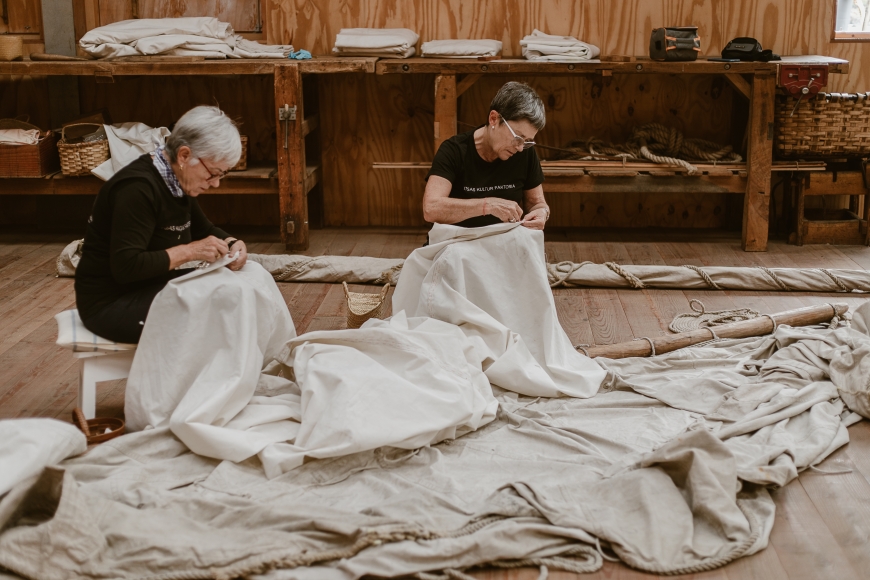
It won´t be long before the replica is ready to set sail. Among other things, the interior work still needs to be finished, including the mast and sails, which are hand-sewn. Meanwhile, the anchors will be made at Albaola’s Ainguraola anchor-making workshop, reviving ancient traditional techniques. Every detail of the new San Juan will be true to its original design, with no modern shortcuts – like an engine.
On the upcoming maritime odyssey to Newfoundland, slated for 2027, the crew will be dressed in period costume and will rely on sail power to make their way. “We´ll have to learn to sail her as we go, because the San Juan has unique characteristics that no one has experienced before. The ship will speak to us and we’ll have to listen,” explains Agote. It will be like tuning an unfamiliar new instrument through trial and error. There’s no other way. Of course, this time no one is going to hunt whales in Newfoundland. The mission will be a cultural, celebratory exchange between two sister nations, the Basque Country and Canada, honoring their shared heritage in style.
Jon Pagola is a freelance journalist who writes about music, culture, and entertainment for various media outlets and publications.